
Conducting the world’s largest AI powered corporate nature assessment for TNFD
Conducting the world’s largest AI powered corporate nature assessment for TNFD

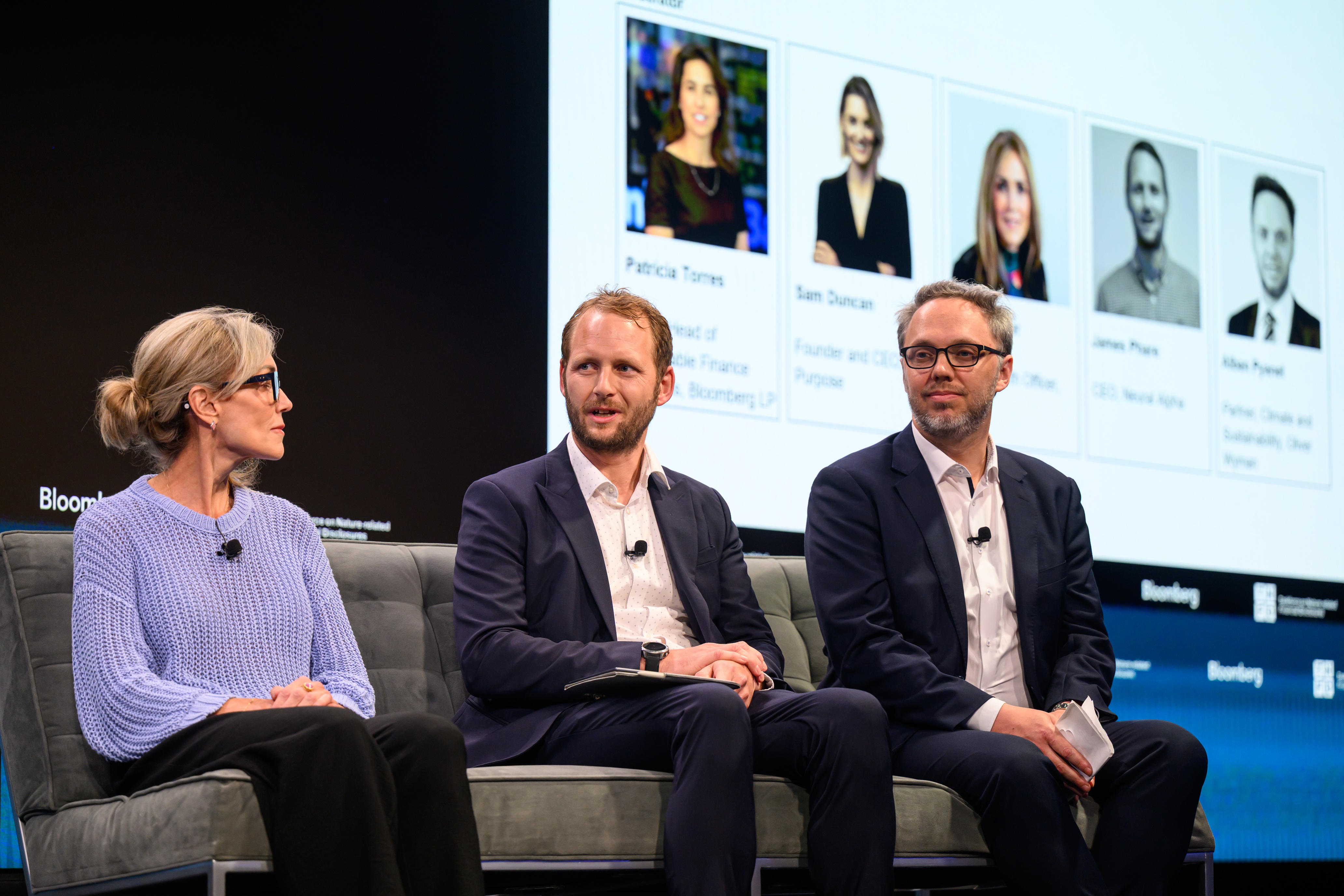
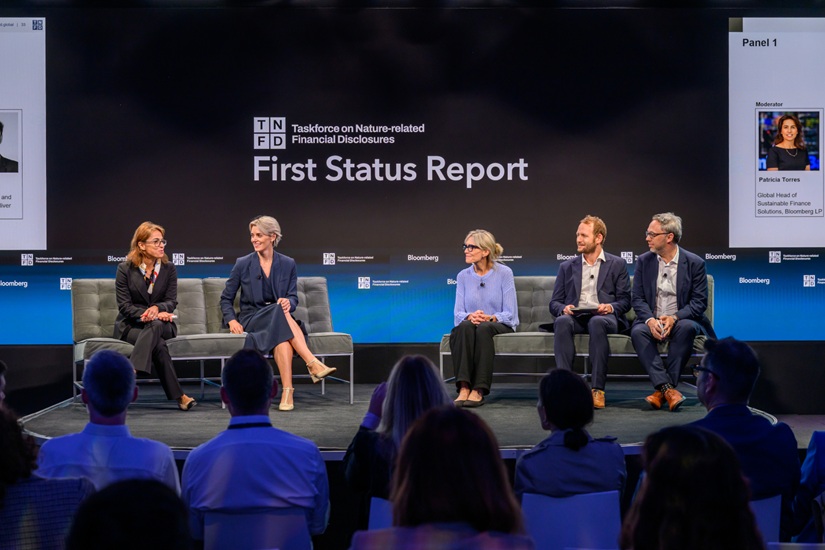
In late September 2025, the TNFD, a global initiative to standardise nature-related financial disclosures, published its first ever Status Report, marking two years since its recommendations were finalised. This milestone report created by TNFD working closely with project partners summarised adoption trends across geographies, industries and company sizes detailing which areas of the framework companies were making the most progress and where opportunities exist to improve the integration of nature into financial decision making and disclosure.
Neural Alpha are proud to have played a central role in this landmark report leveraging our flagship AI platform Responsible Capital, we conducted a first-of-its-kind large-scale, AI-powered assessment of global corporate disclosures — translating the TNFD’s General Requirements, Disclosure Requirements and the LEAP framework into a scalable, automated analysis of the world’s largest companies.
Key outcomes and statistics:
- Analysed 1.4 million corporate disclosure documents, for 7,000 companies, to assess alignment with the TNFD recommendations
- Over 500 companies identified to be publishing TNFD aligned reports
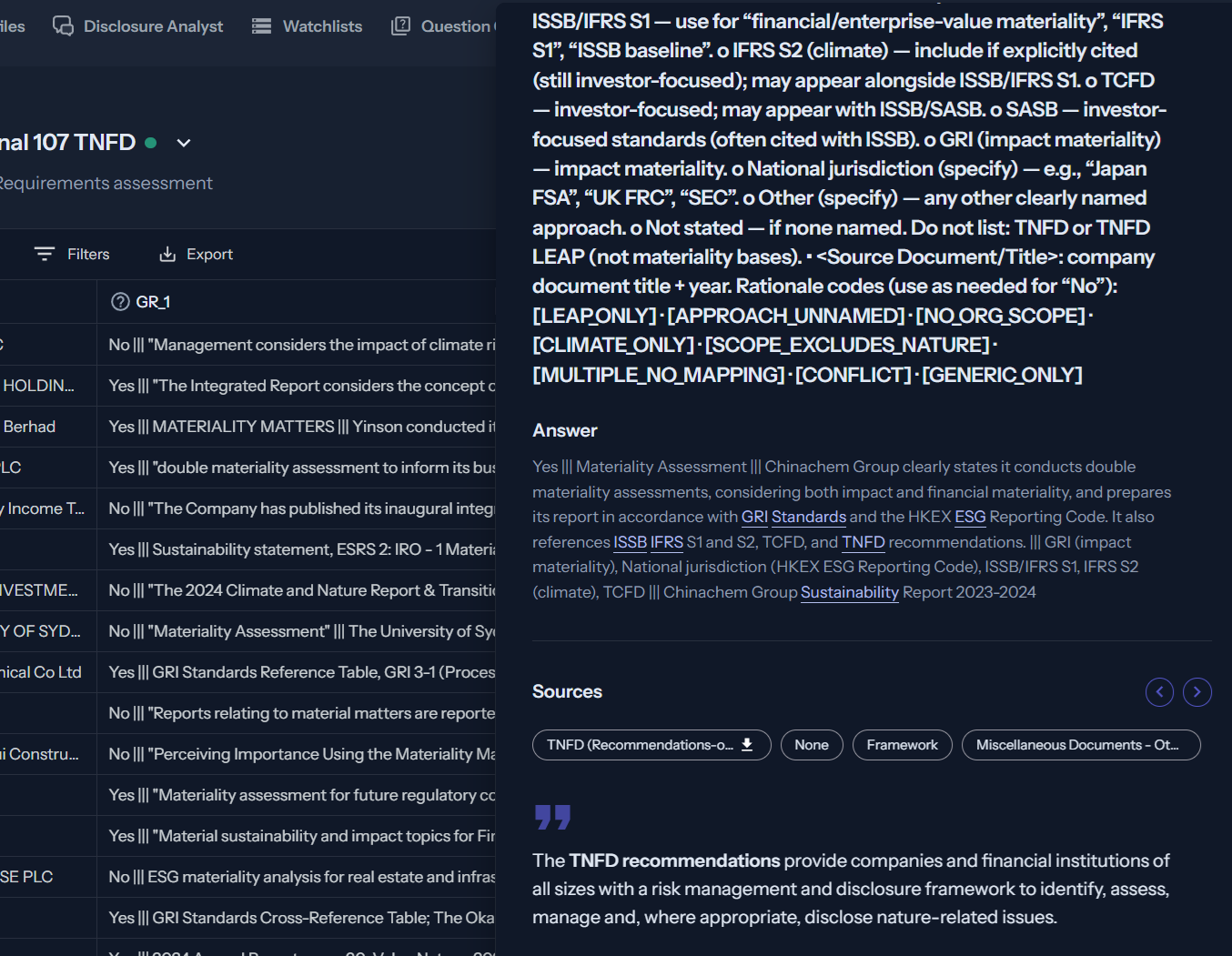
- Translated TNFD disclosure framework into over 30 AI prompts
- Neural Alpha analysed over 30 different report types including Annual Reports, Sustainability reports, corporate policies and other content in 193 different languages
This represents the largest known exercise to date assessing how companies are reporting on nature-related financial risks and dependencies and demonstrates the power of AI to deliver insights on nature related risks, dependencies and impacts at scale.
“There’s a lot more activity than most realise — and TNFD is impressively ahead of TCFD at a similar point in its release cycle.”
The report points to unprecedented momentum as momentum changes and companies increasingly integrate nature into decision-making and disclosure. The pace is energising: there’s real progress across financial institutions and corporates, and rich data opportunities emerging. The 2025 Status Report reveals that nature is finally gaining a seat at the corporate and financial reporting table. Key findings include:
- 620 organisations, across 50+ countries, representing around USD 20 trillion in assets under management (AUM), have publicly committed to beginning TNFD-aligned reporting. tnfd.global+2tnfd.global+2
- More than 500 first- and second-generation TNFD-aligned reports have already been published. tnfd.global+1
- On average, these organisations report ≈ 8.7 of the 14 TNFD-recommended disclosures — showing early but meaningful adoption. tnfd.global+1
- 63% of companies and financial institutions surveyed believe their “nature-related issues” are as significant — or more significant — than climate-related issues for their future business prospects. tnfd.global+1
- 78% of those that have reported say they integrate nature reporting with their climate reporting — underlining a shift toward more holistic sustainability disclosure practices. tnfd.global+1

Working alongside project partners Oliver Wyman, Bloomberg, CDP and Net Purpose we deployed our Responsible Capital AI platform to run a first-of-a-kind global assessment of the extent of TNFD disclosure —translating TNFD’s General Requirements, Disclosure Requirements and LEAP approach into a series of AI prompts — and analysed 1.4M corporate disclosures for 7k companies, comparing results with smaller survey datasets. Results were then triangulated for consistency with other project partner's data and TNFD adopter survey results and to ensure our AI model was performing as expected.
The technical leadership of the TNFD team really has to be commended. They were prepared to try a bold new approach, and it has paid dividends providing a replicable blueprint for financial institutions and corporates to follow. Gone are the days of the volume and complexity of data being a barrier to integrating nature into decision making about portfolio companies and suppliers - TNFD have shown through this project AI can be powerful enabler.
“With AI, it’s very achievable to integrate nature data at scale — especially for downstream companies and financial institutions.”
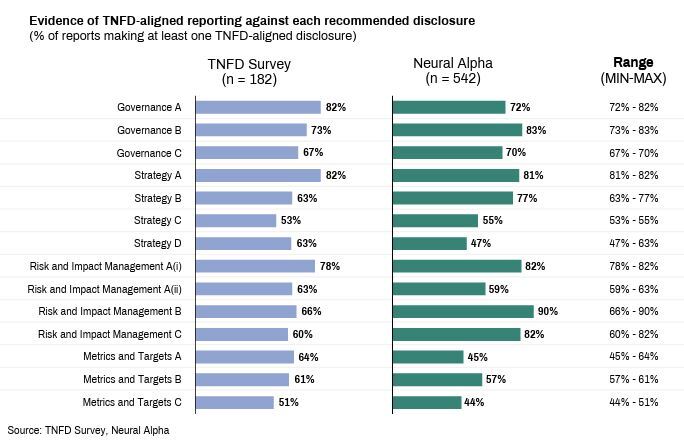
The TNFD’s first reporting cycle shows that nature-related disclosure is no longer a niche concern — it is rapidly emerging as mainstream across geographies, sectors, and capital providers. tnfd.global+2Passle+2
Yet this is just the beginning. The Report notes that many challenges remain: inconsistent data quality, gaps in coverage, varying maturity across regions — and a clear need for scalable approaches. tnfd.global+1
This is where AI-powered platforms like Responsible Capital become indispensable. By automating the parsing and semantic analysis of hundreds of thousands of disclosure documents, AI enables rapid and consistent assessment of nature-related disclosure at scale. This in turn supports investors, regulators, and corporates in identifying dependencies and risks related to biodiversity, water, land use, and other nature-related exposures — essential for directing capital toward a nature-positive future.
This project is a strong case study in Responsible AI as Neural Alpha calculated using an LCA model the energy and water usage in training and running the analysis such that it could be offset via carbon credit purchases. Not only would a project of this scale not have previously been possible within the timeframes every alternative method for achieving the same results generated a significantly higher environmental impact. Across alternate project scenarios, calculating environmental impact (embedded water and energy usage) showed the AI-led approach used a fraction of the resources of human-led and technology-assisted methods. Used wisely, this is a paradigm-shifting capability that sustainability professionals should be embracing.
Read the full report: TNFD Status Report
Further reflections from our CEO on LinkedIn
.jpg)
Ready to drive sustainable growth in your business?
Arrange a demo and free trial now
Related posts
Contact us now and we’ll talk you through the latest news in the ESG industry and the opportunities for your business.

.jpg)
The ESG Events Newsletter for December 2022
.jpg)

Does Board Independence Matter for Performance? It’s Complicated

Trase Finance